Selkirk vs JOOLA vs CRBN: How to Choose Your Pickleball Paddle
Selkirk vs JOOLA vs CRBN for rec players over 50: Selkirk for control and range, JOOLA for power, CRBN for raw carbon feel. Start at 16 mm, about 8 oz.
SmartSelect Labs is reader-supported. If you buy through a link on this page we may earn a small commission, at no extra cost to you. How we make money.
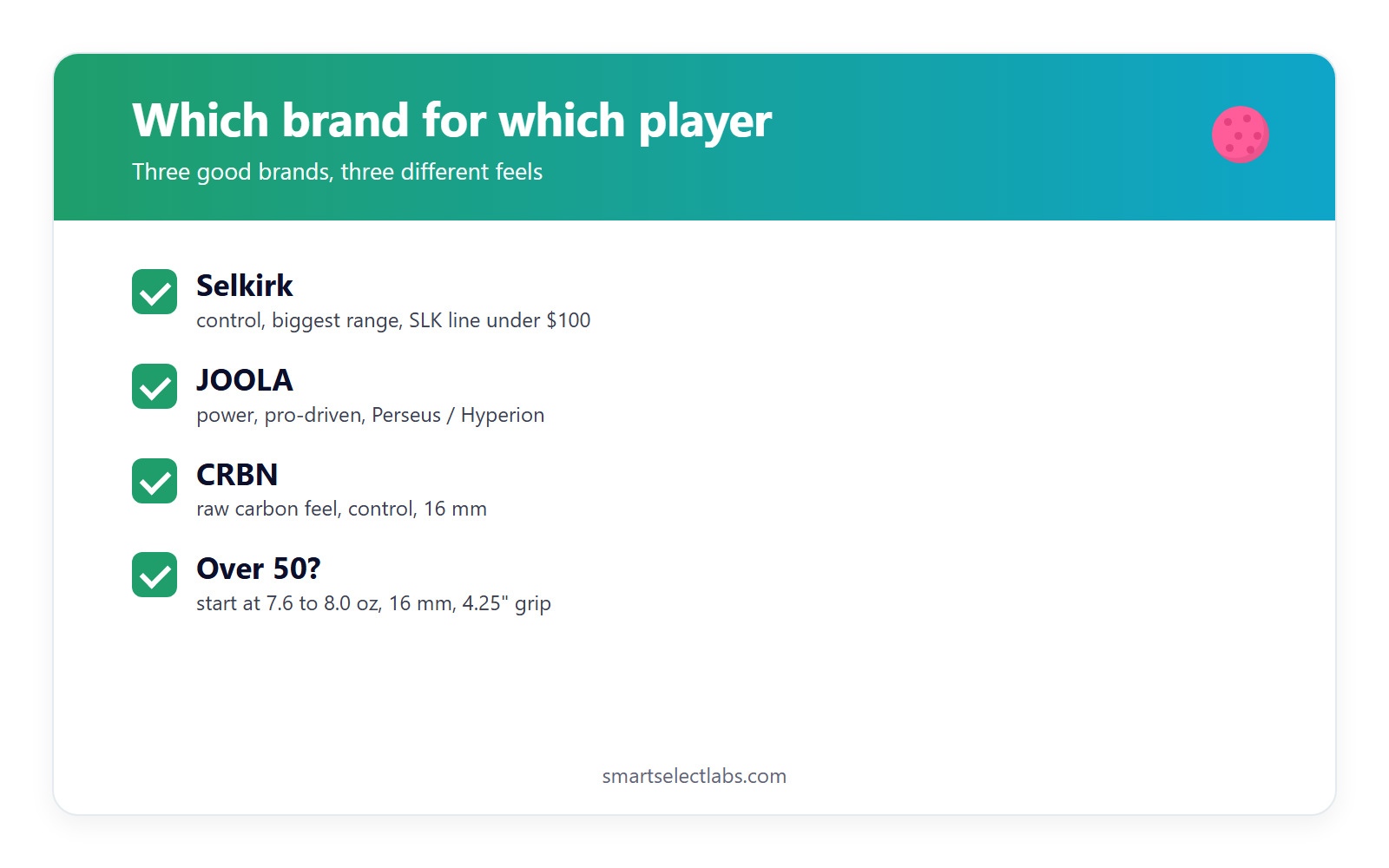
If you play at the park a few mornings a week and want one paddle that lasts, start here. This Selkirk vs JOOLA vs CRBN comparison gives you the short answer. Selkirk for control and range, JOOLA for power, CRBN for raw carbon feel. Why do so many rec players land on Selkirk? The brand sells a real paddle at every price, from an SLK model under $100 to a flagship built in the USA.
Selkirk SLK Halo (Control)
16 mm, raw carbon face, forgiving, priced like a starter paddle
Check price at SelkirkCRBN 2X (16 mm)
Widebody shape, soft feel and the biggest sweet spot of the group
Check price at CRBNJOOLA Ben Johns Perseus (16 mm)
Elongated power paddle with pro-level spin
Check price at JOOLAJOOLA Essentials
A real paddle brand at a starter price; fine for a first season
Check price at AmazonWhat each of the three brands does best
Each brand has a clear personality. That personality tells you more than any model name, because models change every year and the lines stay.
Selkirk: control, choice and a USA-built flagship
Selkirk made its name on control paddles with a big sweet spot. The SLK line is the entry door. It starts under $100 and includes a raw carbon option, the SLK Halo. The Luxx Control Air line is the plush one, with a thick 20 mm core that calms fast balls. The Vanguard line sits at the top, and Selkirk builds it in its own factory in Idaho. Selkirk’s paddle page lists core, weight and grip for every model, so the brand is easy to shop.
JOOLA: power, spin and the Ben Johns paddles
JOOLA is the power brand. Its pro paddles carry the name of Ben Johns, the best-known men’s pro in the sport. The Perseus line is the lighter, faster one. The Hyperion line carries more weight in the head and hits harder. Both come in 14 mm and 16 mm. JOOLA refreshes them about once a year with a new suffix (the current ones say Pro IV), so shop by line name. The Essentials line is the under-$100 entry point at JOOLA’s store.
CRBN: raw carbon feel and a foam-core first
CRBN (say “carbon”) built its name on raw carbon fiber faces. The X series comes in three shapes: 1X elongated, 2X widebody and 3X hybrid, in 14 mm or 16 mm. The feel is soft and grippy, which is why control players love it. The TruFoam Genesis line swaps the usual honeycomb core for a full foam core at 14 mm. It is the newest tech of the three brands, and the priciest. Both lines live at CRBN’s store.
Selkirk vs JOOLA vs CRBN: the specs that matter
Weight. Most paddles from all three brands land between 7.6 and 8.3 oz. If you are over 50, or your elbow has ever complained, stay at 8.0 oz or under. A heavier paddle hits harder, but your arm pays for it by the third game.
Core thickness. 16 mm is the control core, and 14 mm is the power core. A thicker core soaks up more of the ball’s energy. Your shots stay in and your elbow takes less shock. Start with 16 mm unless you already know you want power.
Face material. Raw carbon (the SLK Halo, CRBN, JOOLA’s pro lines) grips the ball for spin and feels soft. Fiberglass (most under-$100 paddles) pops the ball harder and feels livelier, but it wears sooner.
Grip, shape, price and warranty
Grip size. 4.25” fits most adults, and all three brands treat it as the standard. A quick test: hold the paddle and slide a finger of your other hand between your fingertips and your palm. It should just fit.
Shape. Widebody paddles give you the biggest sweet spot and the most forgiveness. Elongated paddles add reach and power but shrink the sweet spot. Standard shapes sit in between.
Price band. Entry paddles run under $100 (Selkirk SLK, JOOLA Essentials). Mid-range raw carbon runs about $100 to $200. Flagships run $200 to $280 across all three brands.
Warranty and where to buy. Each brand covers manufacturing defects for a set period, and the terms differ by line. Read the warranty page before you check out. Buy from the brand store or from an Amazon listing that the brand itself sells. Counterfeit pro paddles exist, and a fake has no warranty at all.
If your elbow already hurts, a lighter 16 mm paddle helps, but it does not replace rest. The Mayo Clinic’s page on tennis elbow explains when to see someone.
Side by side
| Paddle | Core | Face | Shape | Best for | Amazon |
|---|---|---|---|---|---|
| Selkirk SLK Halo (Control) | 16 mm | raw carbon | standard | First paddle | Check price |
| Selkirk Luxx Control Air | 20 mm | carbon | standard or elongated | Control, sore elbows | Check price |
| JOOLA Ben Johns Perseus | 14 or 16 mm | carbon | elongated | Power with spin | Check price |
| JOOLA Ben Johns Hyperion | 14 or 16 mm | carbon | elongated, head-heavy | Maximum power | Check price |
| CRBN 2X | 14 or 16 mm | raw carbon | widebody | Arthritis, control | Check price |
| CRBN TruFoam Genesis | 14 mm foam | carbon | 1, 2 or 3 shapes | Newest tech | Check price |
Our picks, player by player
Best first paddle: Selkirk SLK Halo (Control)
The SLK Halo is our first-paddle pick. It has the 16 mm core, the raw carbon face and the 4.25” grip from the checklist above. It costs about half of a flagship. Selkirk sells it in Control, Power and Max versions, and the Control version is the one to buy first.
Why it works: the face grips the ball, so dinks and drops stay low without a perfect swing. Off-center hits still go in. And the weight sits in the range most players over 50 can swing for two hours.
Buy it if
- this is your first real paddle and you want it to last past month one
- you play doubles and want the ball to land in, not fly long
Pass if
- you already hit hard and want more pop off the face
- you want to spend under $100
The Selkirk button above has the full SLK range, including the Power and Max versions.
Best for tennis elbow or arthritis: CRBN 2X in 16 mm
The 2X is CRBN’s widebody shape. That matters for sore joints for two reasons. A wide face has the biggest sweet spot, so off-center hits still feel soft. And the 16 mm core takes the sting out of hard balls before it reaches your elbow. Pair it with the 4.25” grip and hold it loosely.
CRBN’s raw carbon face adds spin without extra swing effort. You can hit a soft dink with a short, relaxed motion. That is the whole point when your wrist or fingers ache.
If you would rather stay with Selkirk, the Luxx Control Air does the same job with a 20 mm core. Either way, pain that changes how you swing is a reason to rest and see a physical therapist.
Buy it if
- you have tennis elbow, arthritis or a wrist that aches after doubles
- you play mostly the soft game: dinks, drops and resets
Pass if
- you want reach for overheads (look at the 1X or an elongated JOOLA)
- you want to spend under $150
Pick the 16 mm version, not the 14 mm, if your elbow is the reason you are here.
Best for power: JOOLA Ben Johns Perseus in 16 mm
Former tennis players swing big and hit flat. The Perseus rewards that. Its elongated shape reaches a little farther, and the carbon face adds spin on drives. The 16 mm version gives some control back. That is why we point most rec players there instead of the 14 mm.
The Hyperion line hits harder still, but the weight sits in the head. That suits a 30-year-old with a strong shoulder and tires the rest of us. Power paddles also punish late swings, so skip this pick if you are new or your elbow hurts.
Buy it if
- you played tennis and still swing big
- you want spin and drive speed more than touch
Pass if
- your elbow or shoulder complains after a long session
- this is your first paddle
Check the model suffix against JOOLA's own site so you get the current generation, not last year's.
Best under $100: JOOLA Essentials (or Selkirk’s entry SLK)
Not everyone needs a $200 paddle in year one. JOOLA’s Essentials line and Selkirk’s entry SLK paddles both give you a real brand and a 4.25” grip for under $100. The faces are fiberglass or basic carbon rather than raw carbon, so you get more pop and less feel.
That trade is fine for a first season. You learn the dink, the third shot and the serve with it, then move up once you know what you like. The one thing we would not do is go cheaper than this. No-name sets often have thin cores and grips that come apart.
Buy it if
- you are in your first few months and still deciding how often you will play
- you want a spare paddle for a friend or a grandchild
Pass if
- you already play three times a week
- you have elbow pain (spend the extra on a 16 mm raw carbon paddle)
The Amazon button in the picks box above searches the JOOLA Essentials line.
What “USA Pickleball approved” means
Every tournament sanctioned by USA Pickleball requires a paddle from its approved list. The main lines from Selkirk, JOOLA and CRBN all carry that approval. For park play and league nights at the rec center, nobody checks. So the stamp matters only if you plan to enter a sanctioned event.
One wrinkle: a new generation can take a few weeks to appear on the list. If you have a tournament coming up, buy the model that already shows there.
Mistakes people make
Buying by pro name. Ben Johns can swing a 14 mm head-heavy paddle for five hours. Most of us cannot. Buy for your arm, not his.
Starting with 14 mm. The power core feels exciting in the store and sends balls long on the court. Go 16 mm first.
Ignoring the weight. Anything over 8.3 oz is a workout. If you are over 50, read the spec line before the reviews.
Buying a used flagship. Cores go soft after a year of hard play, and dead spots do not show in photos. A new SLK Halo beats a tired Perseus.
How we chose
We did not test these paddles ourselves, and we did not weigh them. The picks rest on the brands’ spec pages, the weight and core ranges above, and what rec players over 50 report about each line after a season. We checked that every model named here exists under that name today. We will add our own on-court photos and notes as we play with them.
Common questions
Frequently asked questions
Selkirk vs JOOLA vs CRBN: which is best for a beginner?
Selkirk, for most people. The SLK Halo gives you a 16 mm core and a raw carbon face at about half the price of a flagship. CRBN is close behind if you want the softest feel. JOOLA's pro lines are power paddles, so new players tend to hit long.
Should I get a 14 mm or a 16 mm paddle?
16 mm, unless you already know you want power. The thicker core keeps the ball in, gives a bigger sweet spot and sends less shock to your elbow. 14 mm hits harder but needs a cleaner swing. All three brands offer their main lines in both.
Which paddle is best for tennis elbow?
A widebody 16 mm paddle at 8.0 oz or under, with a 4.25" grip and a loose hold. The CRBN 2X and the Selkirk Luxx Control Air are the two to look at first. Lighter helps, but rest helps more. If pain changes your swing, see a physical therapist.
Do I need a USA Pickleball approved paddle?
Only for sanctioned tournaments. The main lines from all three brands carry the approval, so you will have it anyway. At the park and in rec-center leagues, nobody checks. If you plan to compete, buy a model that already appears on the approved list.
Should I buy from the brand store or from Amazon?
Either, as long as the seller is the brand itself. The brand store has every version and a simple warranty claim. Amazon is faster and often matches the price. Avoid third-party sellers on pro paddles, because counterfeits exist and carry no warranty.
The bottom line
New to the sport? Our complete beginner’s guide covers the rules and what to buy in month one. Before you spend more, read the smart pickleball shopping guide. It shows where your money matters (shoes first) and where it can wait.

SmartSelect Labs is a small, family-run blog written for people who play at the park, the rec center or the community court. We explain the game in plain English and recommend gear by saying who it is for and why.