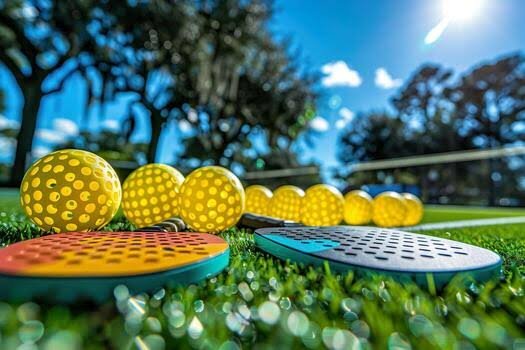
Pickleball for Beginners: The Complete Guide to Getting Started
Pickleball for beginners, explained simply: what the game is, the gear you really need, kitchen and scoring basics, and the mistakes to avoid.
SmartSelect Labs is reader-supported. If you buy through a link on this page we may earn a small commission, at no extra cost to you. How we make money.
If you’re looking for a pickleball for beginners guide that doesn’t assume you already play tennis, this is it. Pickleball has quickly become one of the most popular recreational sports in the United States, and what started as a small backyard game is now a favorite for people of all ages and fitness levels. Maybe you’ve seen a group playing at the park, maybe a friend keeps inviting you, or maybe you’re just curious what the fuss is about.
The good news: you don’t need to be an athlete to start. The rules are easy to pick up, the equipment is simple, and you can play casually while you improve at your own pace.
This guide covers everything you need before your first game: the gear, the basic rules, the kitchen, scoring, simple beginner strategy, what to wear, and the mistakes that trip up almost every new player.
What is pickleball?
Pickleball is a paddle sport played with a solid paddle, a lightweight plastic ball with holes in it, and a net. It can be played as singles (one player per side) or doubles (two per side). Doubles is by far the most popular, because it’s social and you share the court with a partner.
The game borrows from tennis, badminton and table tennis, but it has its own rules and rhythm. The court is much smaller than a tennis court and the ball travels more slowly, which is exactly why beginners can enjoy it on day one while experienced players still find plenty to master.
Why has pickleball become so popular?
There isn’t one reason, there are four, and they tend to stack up.
It’s easy to learn. You can pick up the basic rules in a single session. Nobody needs years of lessons before joining a recreational game.
It’s social. Most pickleball happens at community courts where players rotate partners and meet new people. For a lot of players, the court becomes as much a social spot as a place to exercise.
It’s active without being brutal. The court is small, but you walk, shuffle sideways, bend, reach, stop and start constantly. It adds up to real exercise that doesn’t wreck you.
You can keep improving. Once the basics click, there’s a long ladder of skills to climb: serving, returning, volleys, dinking, drives, lobs, placement, footwork, positioning and communication with a partner. The game has depth.
Pickleball for beginners: what equipment do you need?
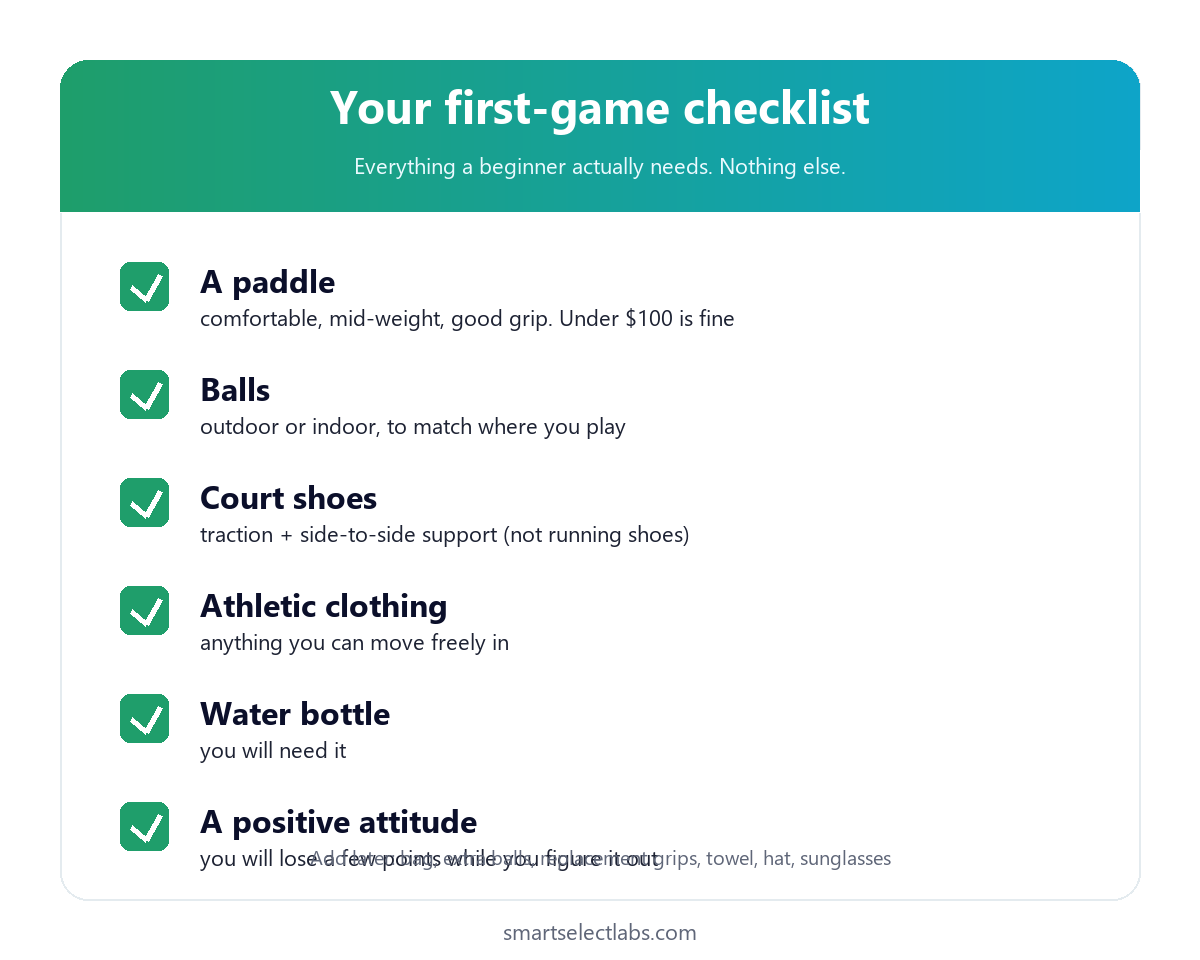
One of the best things about pickleball is how little you need. If you’re just starting, focus on four essentials.
1. A paddle
The paddle is the most important thing you’ll buy, and the most confusing to shop for. Paddles vary by weight, shape, grip size, face material, handle length and price, and beginners often assume the expensive one must be better.
It usually isn’t, at least not for you yet. Look for a paddle that feels comfortable and gives you a good balance of control and maneuverability. Here’s what matters:
- Weight: it shouldn’t feel heavy or tiring. Most beginners do well in the mid-weight range, roughly 7.5 to 8.2 ounces.
- Grip: your hand should feel secure without squeezing. If your fingertips dig into your palm when you grip it, the handle is too small.
- Shape: standard shapes give the biggest sweet spot; elongated shapes add reach but shrink the forgiving area.
- Material: composite and fiberglass faces tend to give more pop, carbon fiber tends to give more control. Either is fine to start.
- Price: there are good beginner paddles well under $100.
- Comfort: honestly the most important factor on this list.
SmartSelect Tip: If you can borrow or test a few paddles before buying, do it. A paddle that feels great in your friend’s hand may feel wrong in yours. Many community groups keep loaners for exactly this reason.
2. Pickleballs
Pickleballs are plastic balls with holes, and they come in two types. Outdoor balls are harder, have smaller holes and are built to survive rough courts and a bit of wind. Indoor balls are softer with larger holes and suit gym floors.
The rule is simple: buy the type for where you play. If you play both, keep a few of each in your bag.
3. Court shoes
Shoes are the piece of gear beginners most often underestimate. Pickleball isn’t a forward-and-back sport. You move side to side, charge the net, back up, pivot around your partner and stop on a dime.
That’s why court shoes beat running shoes. Running shoes are built for straight-line motion and offer little sideways support, which is how ankles get rolled. Look for:
- a comfortable, secure fit
- good traction on hard courts
- lateral (side-to-side) support and stability
- enough cushioning for an hour or two of play
- breathability and durability
The best shoe isn’t the most expensive one. A shoe that fits your foot properly and feels stable beats a heavily advertised model that doesn’t.
4. Clothing
There’s no special pickleball wardrobe. Comfortable athletic clothing is enough: shorts, skirts, athletic dresses or lightweight pants, with a t-shirt or moisture-wicking top. Outdoors, add a hat or visor, sunglasses, sunscreen, a light jacket for cool mornings and a towel. The only real rule is that your clothing lets you move freely.
Understanding the court
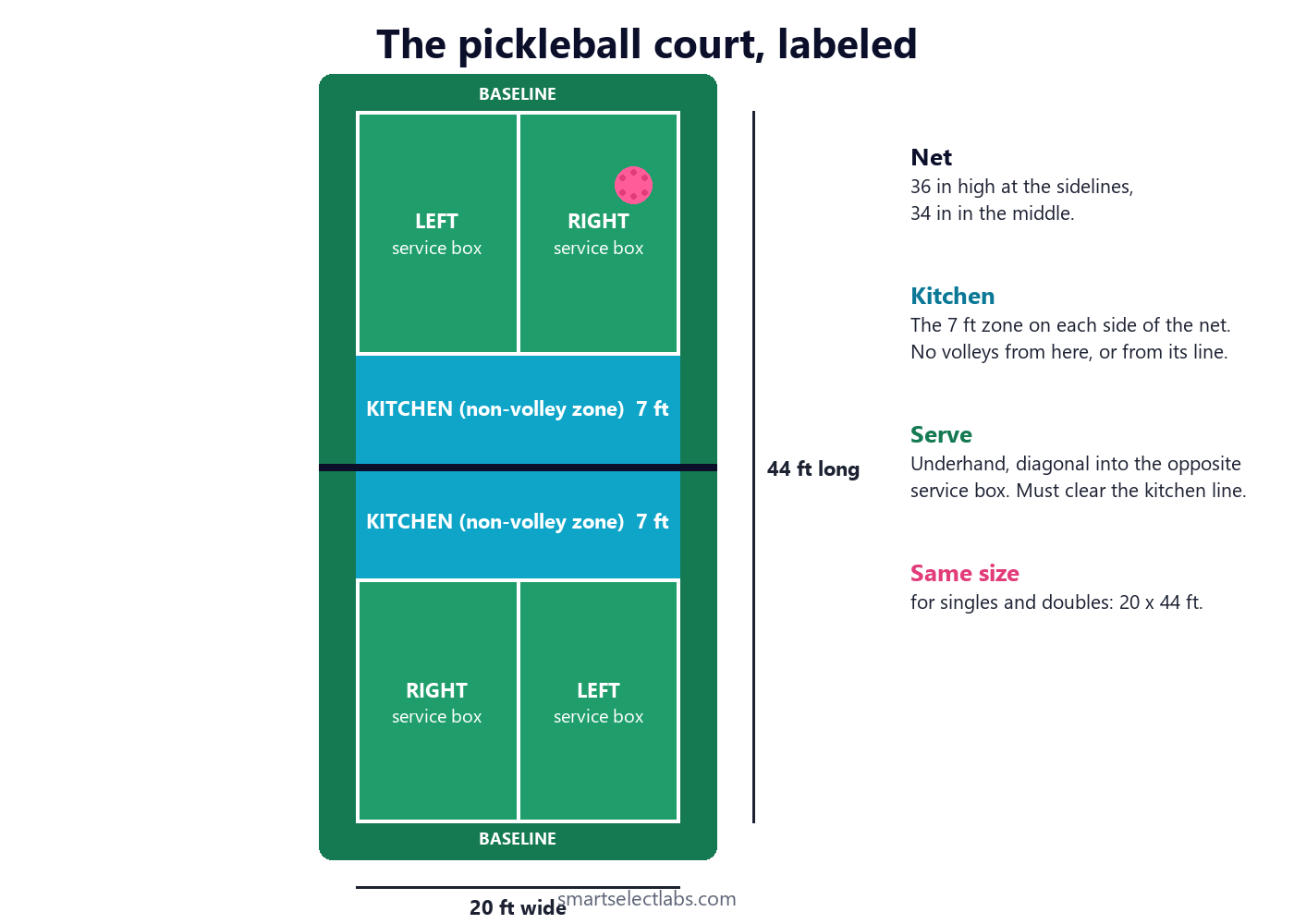
Knowing the court makes everything else easier. A pickleball court has a net across the middle and a few marked areas. The one beginners must understand first is the non-volley zone, which everyone calls the kitchen.
What is the kitchen?
The kitchen is the area closest to the net. It extends seven feet from the net on each side. The rule: you cannot hit a volley while standing in the kitchen (a volley is hitting the ball out of the air before it bounces). This stops players from camping at the net and smashing everything, and it’s the reason pickleball has such a distinctive, patient style of play. As you improve, you’ll discover that controlling the kitchen line is most of the game.
The serve and the return
Every rally starts with a serve. The server hits the ball underhand, diagonally across the court into the opponent’s service area. When you’re new, don’t chase power. Your first goal is consistency. A serve that reliably lands in is far more valuable than a big serve that goes out every third time. Once it’s reliable, work on placement, depth and direction.
After the serve, the receiver returns the ball. A controlled, deep return is your friend: it buys you time to move into a good position. Many beginners try to crush the return. Instead, focus on keeping the ball in play, controlling direction, getting depth, and recovering your position for the next shot.
For the full rules, including the two-bounce rule and how to call the score, read our pickleball rules for beginners guide. The official rulebook lives at USA Pickleball if you ever need the fine print.
How does scoring work?
Traditional games are played to 11 points and you must win by two. Only the serving side can score. That’s the classic format, but scoring can vary by group and competition, so at a new court just ask: “What scoring are we using?” It’s much better than spending the whole game confused.
Singles vs. doubles
In singles you cover the whole court yourself, so there’s more running and more responsibility. In doubles you share the court and the workload, which makes it more social and a little easier on the legs. Communication becomes the key skill: you and your partner need to agree on who takes which ball.
Beginner strategy: four things that actually matter
You don’t need a complicated game plan. Focus on these fundamentals and you’ll win more rallies than you expect.
Keep the ball in play. Consistency is the most valuable beginner skill. If you keep the ball in while your opponents make mistakes, you win points without hitting anything spectacular.
Don’t always hit hard. The powerful shot isn’t always the best shot. A softer, well-placed ball often does more.
Watch your position. After you hit, don’t stand and admire the shot. Reset and get ready for the next one. Where you stand matters as much as how you hit, and good positioning gives you more time to react.
Talk to your partner. In doubles, simple calls like “mine” and “yours” stop both of you going for the same ball, or both leaving it.
7 common mistakes beginners make
- Hitting every ball hard. Power isn’t everything. Control comes first.
- Standing still. Pickleball needs movement. Even small adjustment steps improve your position.
- Forgetting the kitchen. Learn the kitchen rule early; it’s the one you’ll get called on.
- Wearing running shoes. They lack the sideways support court shoes give you.
- Buying expensive gear too soon. You don’t need pro-level equipment to enjoy your first games.
- Going quiet in doubles. Talk to your partner.
- Getting frustrated by mistakes. Mistakes are the learning. Every good player started exactly where you are.
How to improve
Improvement comes from practice, but you don’t need hours a day. Pick one skill at a time and give it ten focused minutes:
- Serve: work on consistency, not speed.
- Forehand: controlled contact, smooth swing.
- Backhand: keep it relaxed and compact.
- Soft shots: develop touch, especially near the kitchen.
- Footwork: shuffle side to side and practice getting into position before the ball arrives.
And play with better players when you can. You’ll learn positioning and strategy faster by watching than by reading, and most experienced recreational players remember exactly what it was like to be new. Ask questions.
What should you buy first?
If you’re building your first setup, keep it simple:
- Paddle: a comfortable, beginner-friendly paddle.
- Balls: indoor or outdoor, depending on where you play.
- Court shoes: comfort, traction and lateral support.
- Athletic clothing: anything that lets you move.
- Water bottle: you’ll need it.
Three beginner-friendly picks
These are the three things we’d put in a brand-new player’s bag. Each link opens the current listing on Amazon.
Selkirk LUXX Control Air paddle
Best for: beginners who want a soft, controllable paddle that they will not outgrow in a month. A step up from a starter set, but it is the paddle we see most new players settle on.
We may earn a commission if you buy through these links. It never changes what you pay.
Franklin X-40 outdoor pickleballs (12 pack)
Best for: anyone playing outside. The X-40 is the ball most outdoor courts and tournaments use, so you practice with what you will actually play with.
We may earn a commission if you buy through these links. It never changes what you pay.
CRBN Pro Team sling bag
Best for: players who want one bag that holds three paddles, balls, a water bottle and keys, without lugging a backpack. Nice to have, not essential on day one.
We may earn a commission if you buy through these links. It never changes what you pay.
Once you’re playing regularly, you can add a pickleball bag, extra balls, replacement grips, a towel, a hat or visor, sunglasses, a ball holder and a paddle cover. Don’t buy everything at once. Start with what you’ll actually use.
How much should a beginner spend?
There’s no perfect budget. Start simple and upgrade as you gain experience. The biggest mistake is believing expensive equipment will make you a better player. It won’t. A beginner with a comfortable paddle and decent technique will have a far better time than one with a $250 paddle that doesn’t suit them. Think of gear as an investment in comfort and enjoyment, not a shortcut.
Pickleball is about more than competition
You can play to win. You can play to unwind. You can play with friends, with family, or with strangers who become friends. You can use it simply as a way to move more. For many people the social side matters as much as the sport, and that’s a big part of why it has taken off.
Frequently asked questions
Is pickleball hard to learn?
No. The basic rules and movements come quickly. Getting good takes practice, like anything.
Do I need to be athletic?
No. People at every fitness level play and enjoy it.
Is pickleball good for beginners?
Yes. It’s one of the most beginner-friendly sports there is, and you can play recreationally while you learn.
Do I need expensive equipment?
No. Start with reasonably priced gear and upgrade later if you want to.
Indoor or outdoor balls?
Whichever matches where you mostly play. Keep both if you play both.
Are running shoes okay?
For a first try, fine. For regular play, court shoes give the sideways support running shoes don’t.
Is pickleball only for older people?
Absolutely not. The fastest-growing group of players is under 35.
Final thoughts
Starting pickleball doesn’t have to be complicated. You don’t need the most expensive paddle, years of athletic experience, or every rule memorized before you step on the court.
Choose comfortable equipment, learn the kitchen rule, practice your serve and return, pay attention to where you’re standing, and give yourself time. Most of all, enjoy it.
Your first-game checklist: paddle, indoor or outdoor balls, comfortable court shoes, athletic clothing, a water bottle, and a willingness to lose a few points while you figure it out. Start simple. Play often. Learn as you go.
Next up: 5 beginner pickleball tips that fix most mistakes.

SmartSelect Labs is a small, family-run blog written for people who play at the park, the rec center or the community court. We explain the game in plain English and recommend gear by saying who it is for and why.