Pickleball Rules for Beginners: Serving, Scoring and the Kitchen, Explained Simply
Pickleball rules for beginners in plain English: how to serve, the two-bounce rule, the kitchen, scoring and calling the score, and the faults that end a rally.
SmartSelect Labs is reader-supported. If you buy through a link on this page we may earn a small commission, at no extra cost to you. How we make money.
These are the pickleball rules for beginners that actually matter in your first games, in plain English. If you’re new to the sport, you’re probably wondering three things: What do I need? How do I play? And what should I buy? This article answers the middle one. For gear and what to buy first, start with our complete beginner’s guide.
You don’t need to memorize a rulebook. If you understand the five things below, you can walk onto a recreational court tomorrow and play a real game.
The court in 60 seconds
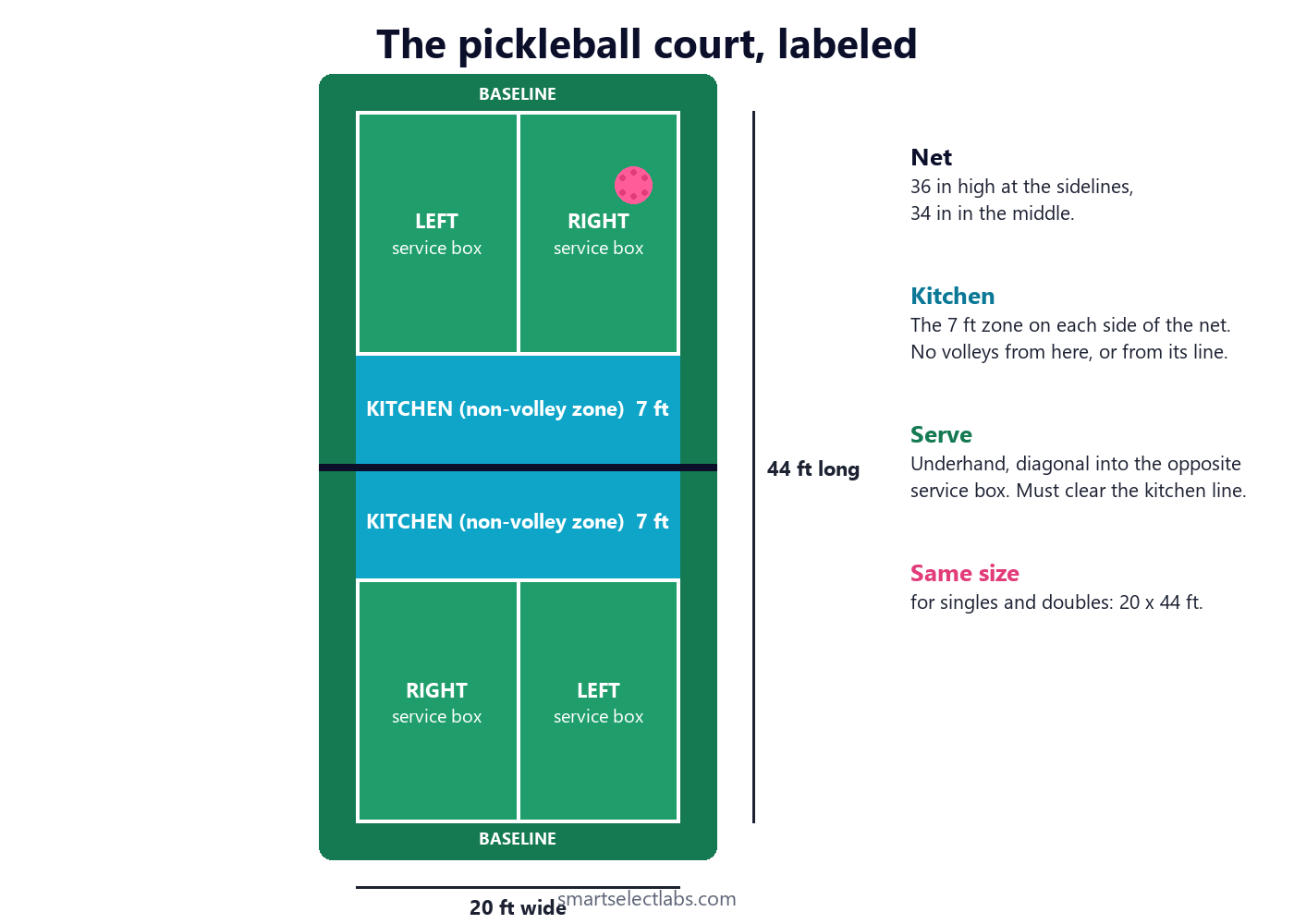
A pickleball court is 20 feet wide and 44 feet long, the same size for singles and doubles. The net is 36 inches high at the sidelines and 34 inches in the middle. On each side of the net there’s a 7-foot strip called the non-volley zone, which everyone calls the kitchen. Behind the kitchen are two service boxes, left and right, and the baseline at the back.
That’s it. Smaller than a tennis court, which is why it’s easier to cover and why the game feels more relaxed.
1. How a point starts: the serve
Every rally begins with a serve, and the serve has a few rules that are easy to get right once you know them.
- Underhand. Your arm swings upward and you make contact below your waist (your navel), with the paddle head below your wrist. You can also use a “drop serve”: drop the ball, let it bounce, and hit it. Either is legal.
- Diagonal. The serve goes cross-court into the opposite service box.
- Clear the kitchen. A serve that lands in the kitchen, or on the kitchen line, is a fault.
- Feet behind the baseline when you hit it.
- One attempt. There are no second serves. If the ball clips the net and still lands in the correct box, you play it. (Older rules replayed these “lets”; modern rules don’t.)
When you’re learning, don’t chase power. A serve that lands in every time is worth far more than a hard serve that goes out. The exact wording of every rule is in the USA Pickleball official rulebook, but you won’t need it for a long time.
2. The two-bounce rule (the one everyone forgets)
This is the rule that separates pickleball from tennis and the one new players break most.
After the serve, the receiving team must let the ball bounce before returning it. Then the serving team must also let that return bounce before hitting it. After those two bounces, anyone can volley (hit the ball out of the air), as long as they’re not in the kitchen.
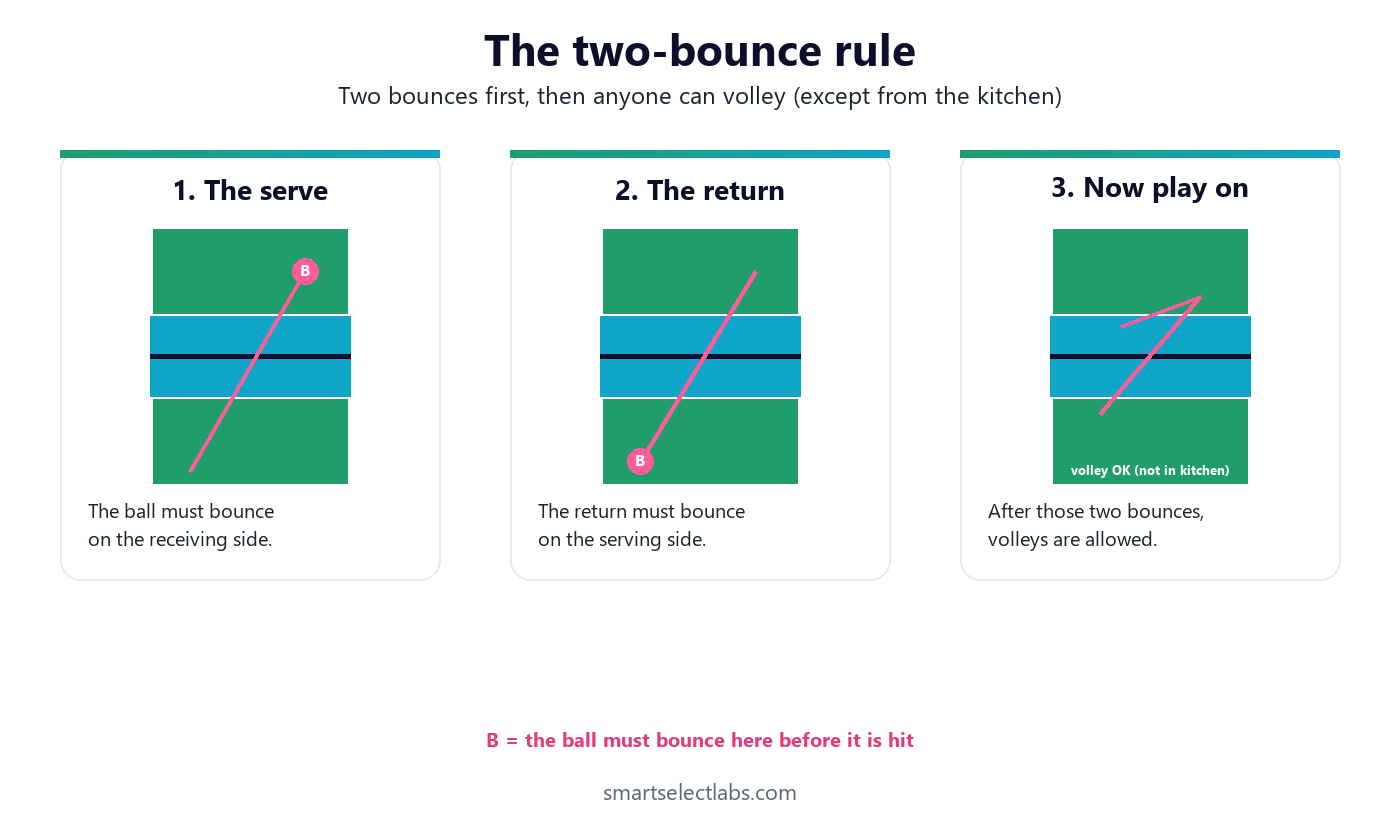
Why it exists: it stops the serving team from rushing the net and smashing the return. In practice it means the serving team should stay back near the baseline after serving, and the receiver’s partner can move up.
3. The kitchen (non-volley zone)
The kitchen is the 7-foot area on each side of the net, and the rule is simple to state: you cannot volley while standing in the kitchen or touching the kitchen line.
A few details that catch beginners out:
- You can step into the kitchen to hit a ball that has bounced. You just can’t hit it out of the air from there.
- If your momentum carries you into the kitchen after a volley, that’s still a fault, even if you hit the ball from outside.
- Dropping your paddle, hat or anything else into the kitchen while volleying is also a fault.
This rule is why pickleball has “dinking”, the soft game of short shots that land in the kitchen where the other team can’t smash them. As you improve, most of the game happens at the kitchen line.
4. Scoring, explained simply
Traditional recreational games are played to 11 points, win by 2. Only the serving team can score a point. When the serving team loses a rally, the serve passes to the other side (a “side out”) and nobody scores.
Calling the score in doubles
Doubles scores have three numbers, which sounds strange until you’ve done it twice: your score, their score, and which server you are (1 or 2). Each team gets two servers per turn, except the very first serve of the game, which starts at 0-0-2 so the opening team only gets one server.
So “4-2-1” means: we have 4, they have 2, and I’m the first server. When the first server loses a rally, the partner serves and it becomes “4-2-2”. When they lose a rally, it’s a side out.
Singles
Singles is simpler: two numbers, your score and theirs. You serve from the right side when your score is even and the left when it’s odd.
Rally scoring
Some rec groups and leagues use rally scoring, where every rally scores a point regardless of who served, usually to 15 or 21. If you’re playing at a new court, just ask: “What scoring are we using?” Nobody minds, and it beats being confused for a whole game.
5. Faults: what ends a rally
A rally ends, and the other side wins it, when you:
- hit the ball out of bounds (lines are in, except the kitchen line on a serve)
- hit the ball into the net
- volley while in the kitchen or touching its line
- break the two-bounce rule
- serve illegally (too high, not diagonal, into the kitchen, foot over the baseline)
- let the ball bounce twice on your side
- touch the net or the net post with your body or paddle
- get hit by the ball, including your clothing, while it’s in play
Five habits that help new players
Once you know the rules, these five habits will make your first weeks a lot more fun.
- Keep the ball in play. Consistency beats power when you’re learning. Most beginner points are lost on unforced errors, not won on great shots.
- Watch the ball. Keep your eyes on it all the way to the paddle instead of looking up to see where it’s going.
- Learn a reliable serve first. Fancy comes later.
- Move your feet. Good positioning makes every shot easier and every reach unnecessary.
- Talk to your partner. In doubles, decide who takes the middle ball before it arrives.
We go deeper on each of these in 5 beginner pickleball tips that fix most mistakes.
What to bring to your first open play
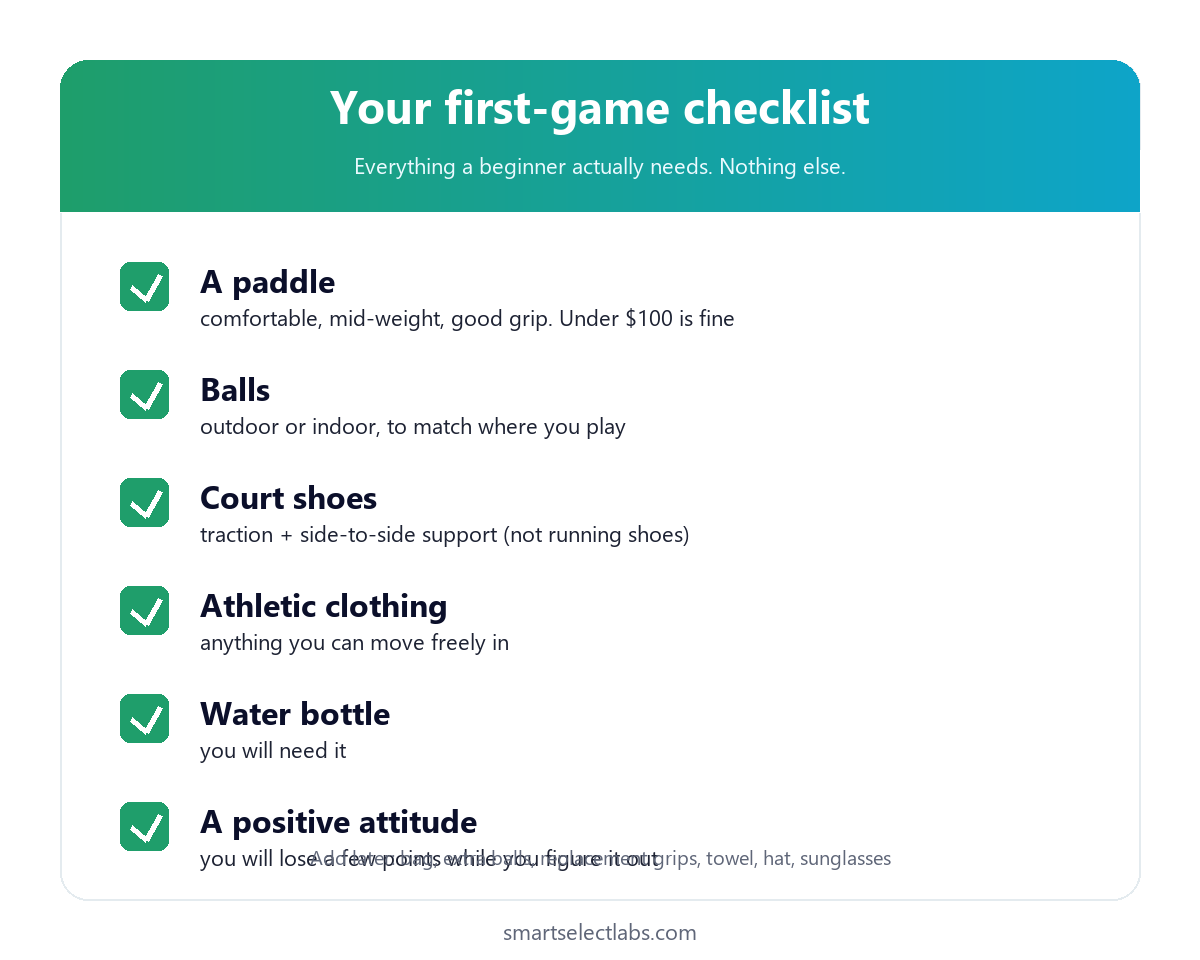
You don’t need to buy everything at once. A simple first setup is one or two paddles, a set of indoor or outdoor balls to match the court, comfortable court shoes, a water bottle, and clothing you can move in. A small bag is nice but optional. Our complete beginner’s guide walks through choosing each of these.
Quick reference: pickleball rules for beginners
- Game to 11, win by 2. Only the serving side scores.
- Serve underhand, diagonal, clear the kitchen, one attempt.
- Two-bounce rule: return bounces, then the next shot bounces, then volleys are allowed.
- No volleys from the kitchen or its line. Momentum counts.
- Doubles score = your score, their score, server number. The game starts 0-0-2.
- Not sure of the local format? Ask.
Final thoughts
Pickleball is a great sport for beginners precisely because the rules are this short. Learn the serve, respect the two bounces, stay out of the kitchen when you volley, and call the score out loud. Everything else you’ll pick up by playing.
At SmartSelect Labs we’re here to make getting started easier, with simple explanations and practical gear advice. Have fun out there.

SmartSelect Labs is a small, family-run blog written for people who play at the park, the rec center or the community court. We explain the game in plain English and recommend gear by saying who it is for and why.