Pickleball Skincare: Sunscreen & Simple Skin Care for Active Players
Pickleball skincare for players over 50 on the court by 9 a.m.: SPF 30+ broad spectrum, reapply at two hours, a hat and sleeves, then a simple after-play plan.
SmartSelect Labs is reader-supported. If you buy through a link on this page we may earn a small commission, at no extra cost to you. How we make money.
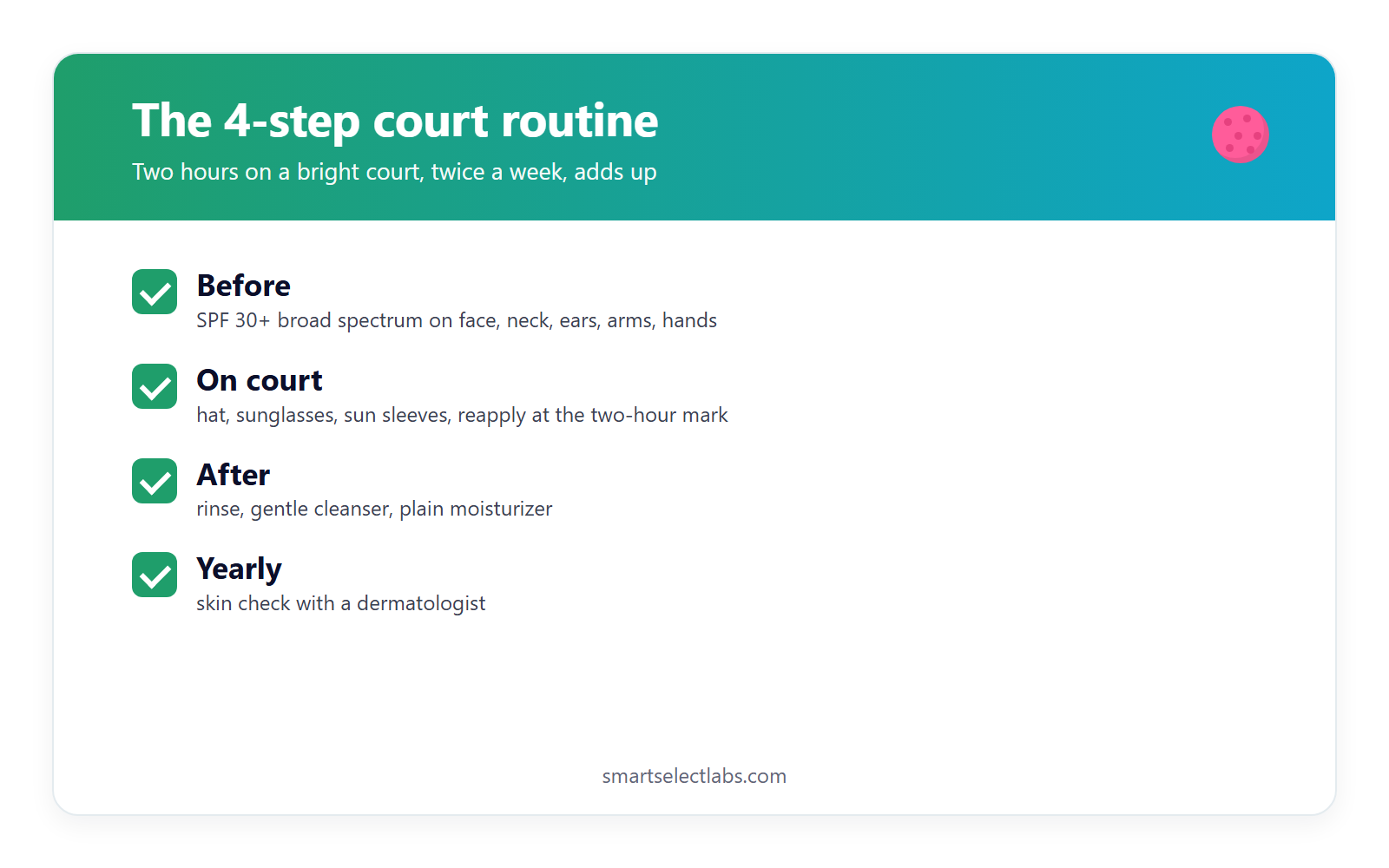
This is for the player who is on the court by 9 a.m. two or three mornings a week, especially if you are over 50. Pickleball skincare comes down to one routine. Put a broad-spectrum SPF 30 or higher on every exposed inch before you leave the house. Reapply at the two-hour mark, wear a hat and sun sleeves, and rinse and moisturize after. The reason is simple. Two hours on a bright court with your arms and neck out, week after week, adds up over years. Most skin cancers trace back to sun exposure.
EltaMD UV Clear Broad-Spectrum SPF 46
Light, zinc-based, no cast; for faces that react to sunscreen
Check price at EltaMDSupergoop PLAY Everyday Lotion SPF 50
Sweat resistant, rubs in clear, big pump lasts a season
Check price at SupergoopBlue Lizard Sport Mineral SPF 50+
Zinc and titanium only, no fragrance, built for sweat
Check price at Blue LizardLa Roche-Posay Anthelios
At any pharmacy, in chemical and mineral versions
Check price at La Roche-PosayWhy a 9 a.m. doubles game is a sun problem
A morning session feels safe because it is cool. It is not. UV strengthens through the morning, and the American Academy of Dermatology names 10 a.m. to 2 p.m. as the hours when the sun’s rays are strongest. A 9-to-11 session spends half its time inside that window. Hard courts also bounce some light back up at you. A visor shades your eyes and leaves your chin, neck and ears to the court.
Then there is the exposed skin. Doubles leaves your forearms, the backs of your hands, your neck and the tops of your ears out for two hours. Many players do that three times a week. One in five Americans develops skin cancer by age 70. That figure comes from the Skin Cancer Foundation. The same page links most skin cancers to sun exposure.
The only pickleball skincare routine that matters
The whole routine fits on an index card. Choose a sunscreen that says broad spectrum (it blocks UVA and UVB), SPF 30 or higher, and water resistant. That is the American Academy of Dermatology’s standing advice. Put it on 15 minutes before you go out. Use enough: about one ounce, a shot glass, covers an adult body, and most people use far less. Cover the parts players forget: ears, the back of the neck and the backs of the hands. Add the part in your hair and the tops of your feet if you wear low socks.
Reapply at least every two hours. Playing past two hours? Put on a fresh coat at the two-hour mark, and sooner if you have sweated hard or toweled off. Keep a travel tube in the paddle bag so there is no excuse.
Lips burn too. The AAD recommends a lip balm with SPF; we carry an SPF 30. Then add the clothing layer. Start with a hat that has a brim all the way around, since a cap or visor leaves ears and neck out. Add sunglasses and UPF 50 sun sleeves for your forearms. Sleeves feel cooler than bare skin in direct sun, and they save you from reapplying on your arms.
Mineral or chemical: pick the one you will wear
Mineral sunscreens use zinc oxide or titanium dioxide. They sit on top of the skin, work the moment you put them on, and rarely sting. That makes them the usual choice for sensitive skin, rosacea, and eyes that burn when you sweat. The trade-off is texture. They spread thicker and can leave a white or gray cast, more so on deeper skin tones.
Chemical sunscreens use filters like avobenzone and octocrylene. They rub in clear, feel lighter under sweat, and go on faster over a hairy forearm. They need about 15 minutes to start working, and some players find they sting the eyes. The AAD’s position is that both types work when you use enough and reapply. The best one is the one you will wear every session. Hybrids exist too: EltaMD UV Clear pairs zinc oxide with a chemical filter to get the lighter feel.
One note on labels. “Water resistant” on a U.S. sunscreen means it held its SPF through 40 or 80 minutes of water or sweat in testing. Nothing is sweatproof. A two-hour session needs a reapply either way.
The six products side by side
| Product | Type | SPF | Best on | Water resistant | Amazon |
|---|---|---|---|---|---|
| EltaMD UV Clear | Hybrid (zinc) | 46 | Face | No, reapply after sweat | Check price |
| Supergoop PLAY | Chemical | 50 | Arms, legs, neck | Yes | Check price |
| La Roche-Posay Anthelios | Chemical or mineral | 50 to 60 | Face and body | Yes | Check price |
| Blue Lizard Sport Mineral | Mineral | 50+ | Body, sensitive skin | Yes | Check price |
| Sun Bum Mineral Lotion | Mineral | 50 | Face and body | Yes | Check price |
| Sun Bum SPF 30 Lip Balm | Lip balm | 30 | Lips | Yes | Check price |
EltaMD UV Clear SPF 46: best for your face
This is for the face that reacts to sunscreen. Think redness, clogged pores, or a sting at the eyes. UV Clear is a thin SPF 46 lotion with zinc oxide and niacinamide. It goes on light enough that you forget it. It leaves no cast on most skin tones. It sits fine under makeup if you go from the court to lunch. EltaMD sells mainly through dermatology offices, which is why your dermatologist probably named it.
The catch for a sweaty sport: UV Clear does not carry a water-resistance rating. On a hot morning, wipe your face with a towel and some of it goes with it. Treat it as the before-play layer and carry a stick or a sport formula for the reapply.
Who should skip it: players who want one tube for face and body. At the price of a small tube, use it on your face and buy a cheaper lotion for your arms.
Buy it if
- your face stings, reddens or breaks out under most sunscreens
- you want a daily face sunscreen that disappears
Pass if
- you want one tube for face and body
- you need a sweat-rated formula for the full two hours
EltaMD UV Clear Broad-Spectrum SPF 46
Best for: faces that react to sunscreen. Light, zinc-based, no cast on most skin. Reapply with a sport formula after a sweaty hour.
We may earn a commission if you buy through this link. It never changes what you pay.
Supergoop PLAY SPF 50 (and Unseen): best for arms and legs
PLAY is the arms-and-legs bottle. It is a chemical SPF 50 lotion, water and sweat resistant, and it rubs in clear in a few seconds. It also comes in a big pump that lasts a season of three sessions a week. That size matters, because the easiest way to under-apply is a tiny tube you are rationing.
Unseen is the other Supergoop players ask about. It is a clear SPF 40 gel that feels like a primer and leaves nothing visible. That suits a face that goes from the court to a meeting. Unseen is a face product; do not try to cover your arms with it.
Who should skip it: anyone who wants mineral only or fragrance free, and anyone on a tight budget. Supergoop sits at Sephora prices, not drugstore prices.
Buy it if
- you want a sunscreen that rubs in clear on arms and legs
- you reapply on court and want a pump, not a tiny tube
Pass if
- you want mineral only or fragrance free
- you want the cheapest bottle that works
Supergoop PLAY Everyday Lotion SPF 50
Best for: arms, legs and neck on court days. Water and sweat resistant, rubs in clear, big pump bottle. Unseen SPF 40 is the face version.
We may earn a commission if you buy through this link. It never changes what you pay.
La Roche-Posay Anthelios: best drugstore pick
This is for the player who buys sunscreen where they buy toothpaste. Anthelios is La Roche-Posay’s sunscreen line, and it sits on the shelf at CVS, Walgreens and Target. The chemical version, Anthelios Melt-in Milk SPF 60, is a runny lotion that spreads fast over a whole body. The mineral version, Anthelios Mineral SPF 50, uses zinc and titanium and comes in a tinted option. Sensitive skin gets a choice in the same aisle.
Both are water resistant, and La Roche-Posay is a brand many dermatologists recommend by name. If you only buy one bottle for the whole family’s court mornings, this is the sensible one.
Who should skip it: players who dislike the dewy finish of the Melt-in Milk on the face. Also anyone who already owns the two picks above.
Buy it if
- you want a dermatologist brand from the drugstore shelf
- you want a chemical and a mineral option in the same line
Pass if
- you dislike a dewy finish on your face
- you already own the two picks above
La Roche-Posay Anthelios (Melt-in Milk SPF 60 or Mineral SPF 50)
Best for: a drugstore sunscreen with a chemical and a mineral option. Spreads fast over a whole body before play.
We may earn a commission if you buy through this link. It never changes what you pay.
Blue Lizard and Sun Bum: the mineral options
These are for skin that stings under chemical filters. They also suit rosacea, eczema, and anyone who wants the shortest ingredient list. Blue Lizard Sport Mineral SPF 50+ uses zinc and titanium only and skips fragrance. The sport formula carries a water-resistance rating for sweaty play. Sun Bum Mineral SPF 50 is the other fragrance-free mineral lotion we see at courts. It is water resistant too; check the label for its 40 or 80 minute rating.
The trade-off with both is texture. They spread thicker than the chemical lotions and can leave a light cast, more visible on deeper skin. Rub in well; a cast that fades in a few minutes is normal.
Who should skip it: anyone who dislikes any cast at all. A tinted mineral or a chemical formula suits you better. Same for anyone who wants a sunscreen that vanishes in seconds.
Buy it if
- chemical sunscreens sting your eyes or your skin
- you want zinc and titanium only, with no fragrance
Pass if
- any white cast bothers you
- you want it to vanish in seconds
Blue Lizard Sport Mineral SPF 50+
Best for: sensitive skin that stings under chemical sunscreen. Zinc and titanium only, fragrance free, made for sweat. Sun Bum Mineral SPF 50 is the softer-feeling runner-up.
We may earn a commission if you buy through this link. It never changes what you pay.
The two small things: an SPF lip balm and a plain moisturizer
Lips burn and nobody remembers them. Sun Bum SPF 30 Lip Balm is broad spectrum and water resistant. It is small enough to live in the bag’s pencil pocket. Swipe it on with your sunscreen and again at the reapply.
After play, your skin carries sweat, sunscreen and court dust. Rinse at the court if there is a fountain. At home, use a gentle cleanser and a plain moisturizer. CeraVe Moisturizing Cream suits dry skin. Vanicream Daily Facial Moisturizer suits a face that reacts to everything. A toner is optional. If you enjoy one, pick an alcohol-free version. It does nothing the cleanser and moisturizer do not already do. Skip the ten-step routine; skin over 50 wants less, not more.
Sun Bum SPF 30 Lip Balm
Best for: the lip SPF everyone forgets. Broad spectrum and water resistant; swipe it on with your sunscreen.
We may earn a commission if you buy through this link. It never changes what you pay.
CeraVe Moisturizing Cream or Vanicream Daily Facial Moisturizer
Best for: the after-play step. Fragrance free, plain, and enough on its own.
We may earn a commission if you buy through this link. It never changes what you pay.
Skin over 50: what changes and what to watch
Skin thins and dries with age. It heals slower, and it carries every summer you spent without sunscreen decades ago. That is why new spots show up now. Good pickleball skincare after 50 is mostly subtraction: fewer products, more moisturizer, and a hat you actually wear. If your dermatologist has you on a prescription retinoid, it can make skin more sensitive to sun. The hat and the reapply matter even more then.
The one addition is the yearly check. The Skin Cancer Foundation advises a monthly self-check. Add a professional skin exam once a year. Learn the ABCDEs (asymmetry, border, color, diameter, evolving). Book an appointment for any spot that is new, changing or bleeding. Same for a sore that does not heal in a few weeks. Found early, melanoma is highly treatable. That appointment matters more than any product on this page.
What to skip
Most pickleball skincare mistakes are habits, not products. Here are the ones we see at the courts.
SPF in your foundation or moisturizer as your only protection. You rarely put on enough of either to reach the SPF on the label. Use a real sunscreen underneath.
Spray sunscreen on a windy court. Half of it lands on the bench. If you use a spray, spray it into your hands and rub it on, and never spray your face.
Last summer’s tube from the hot car. Sunscreen has an expiration date. A tube cooked in a car all summer is past its best regardless. Buy fresh each season.
SPF 100 as an excuse. A higher number adds a little protection, not a license to skip the reapply.
A base tan or tanning oil. There is no safe tan. The AAD is blunt on this: a tan is skin damage.
The ten-step routine. Cleanser, moisturizer, sunscreen. That is the routine.
How we chose these pickleball skincare picks
We did not run a sweat test. These picks rest on the makers’ labels: SPF, broad spectrum, water-resistance rating and active ingredients. We checked them against the AAD’s guidance on what a sunscreen needs. We also listen to what players at our courts reach for and complain about. We lean on brand sites for current formulas because sunscreen lines change often. We will add our own on-court notes as we uses them.
Frequently asked questions
Frequently asked questions
What SPF do I need for pickleball?
SPF 30 or higher, broad spectrum, and water resistant, per the American Academy of Dermatology. Higher numbers add a little, not a lot. Using a full amount and reapplying every two hours matters more than the number on the bottle.
Do I need to reapply sunscreen during a two-hour session?
Yes, if you keep playing. The AAD says to reapply at least every two hours, and sooner after heavy sweating or toweling off. For a two-hour session, put on a fresh coat at the two-hour mark if you stay on. Do it earlier on a hot, sweaty morning.
Is mineral or chemical sunscreen better for pickleball?
Both work when you use enough. Mineral (zinc, titanium) suits sensitive skin and eyes that sting when you sweat. Chemical rubs in clear and feels lighter. Pick the one you will put on every session.
Does pickleball skincare need a toner or a serum?
No. Sunscreen before play, a rinse and a plain moisturizer after, and a yearly skin check cover it. A toner is optional; if you like one, pick an alcohol-free version. Serums and ten-step routines add cost and irritation without adding sun protection.
How often should a pickleball player see a dermatologist?
Once a year for a full skin exam, plus a monthly self-check at home. That is the Skin Cancer Foundation's guidance. Go sooner for any spot that is new, changing, bleeding, or not healing in a few weeks.
Our verdict
The same bag pocket holds the sunscreen and the bottle. See our picks for the best water bottles for pickleball. The full bag checklist is there too. For the hat, sleeves and sunglasses, our pickleball accessories list covers them.

SmartSelect Labs is a small, family-run blog written for people who play at the park, the rec center or the community court. We explain the game in plain English and recommend gear by saying who it is for and why.